On a Vivaadi Note
T.M. Krishna, 'art music', and the question of what art can - and should - do

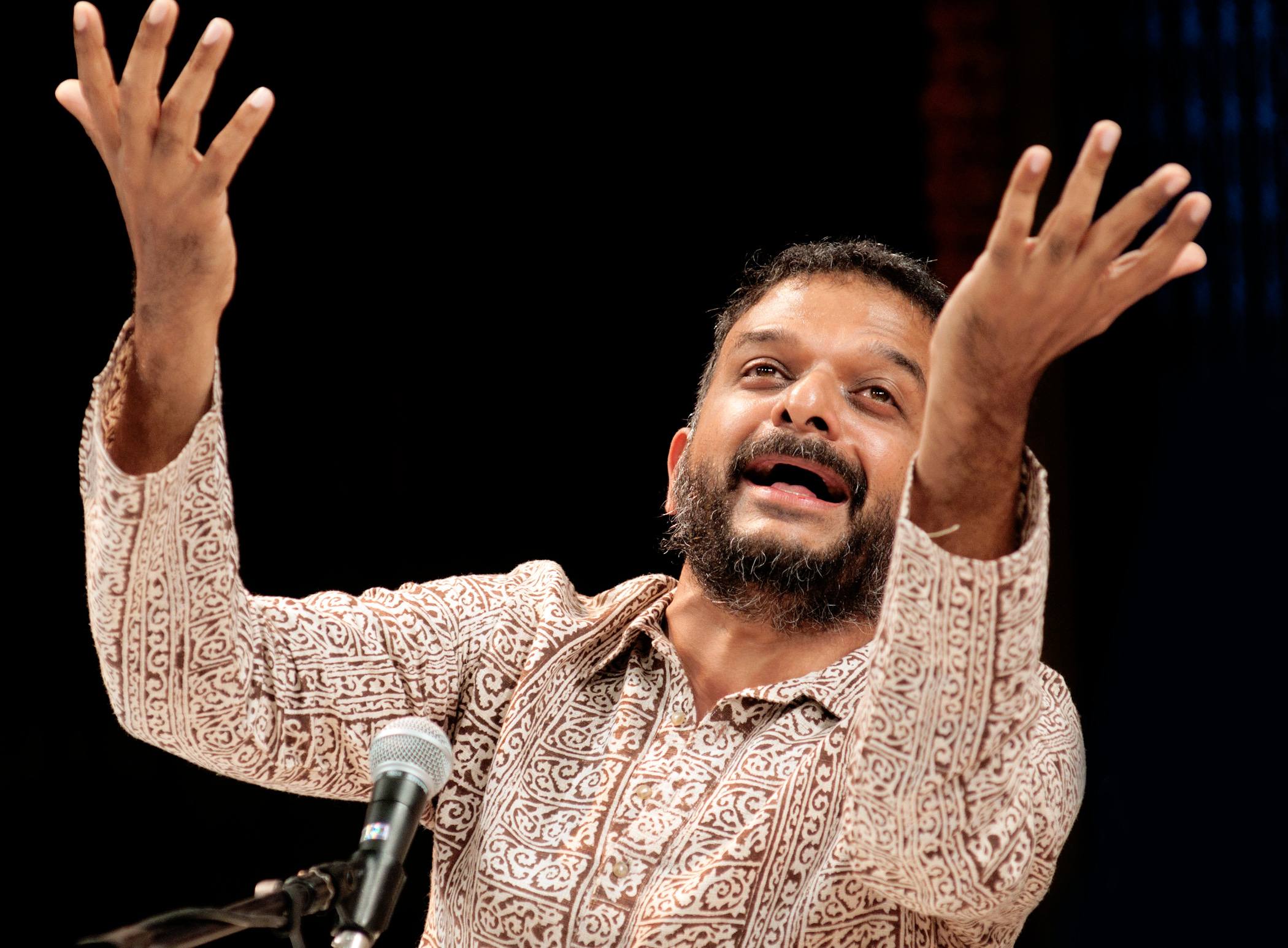
Of all the unfortunate things that can happen to a person, the most unfortunate is being asked to hold on to seats at a concert until the others in their party arrive. Especially if it is one of those rare things these days - a T.M. Krishna concert in Chennai during December Season. In an actual sabha and not at the beach or in a bus or something like that. And did I mention that it was a free concert?
We will be there in about 45 minutes, they said. 'About'. I had placed a token item each on the two seats on either side of me - an empty plastic cover, a water bottle, some pamphlet that someone handed me on the way in, and a book. Yes, I had brought a book along to read while I waited, not knowing that my reserves of strength (and the thickness of my skin) was going to be put through a trail by fire.
I was trying to act nonchalant as I waited with desperately rising impatience. I was trying to avoid looking at the aunty who was standing in the aisle adjacent to the row I was guarding; she kept turning to look at me every two minutes, and each time I stared harder at my phone screen. The crowd in the rather small hall was increasing alarmingly. There were now two more aunties and an elderly couple standing in the aisle. The old man looked at the book sitting apologetically on the seat and asked me, 'Is anyone coming here?'. Yes, I whimpered, they are almost here, just parking the car. He stared at me for a second, coughed, and a shudder seemed to pass through him. To my mind he seemed to be guilt-tripping me. I typed frantically on the phone. 'Where ARE you all?'. 'Almost there,' came by reply, 'about 10 minutes'.
The crowd was now pouring in. People were seating themselves on the steps, they were clinging on to the walls, and they were moving on to the stage. Carnatic concerts usually do have some people seated on the stage, but this was something else. 'Leave some space for the artists!' one of the organizers of the Guruvayoor Dorai Trust concert said. That seemed like a fair request, so the squatters squeezed towards the edge of the stage.
Amid all this, it was quite ridiculous for me to try holding on to 4 empty seats. This was a jungle now, and it was survival of the fittest. I picked up my book off the chair and indicated that the seats were now available. There was a mini stampede to get to those seats, during which time Krishna, Akkarai Subbulakshmi and gang had arrived and seated themselves on stage. A few minutes later the hum of the tambura rang around the hall, and the crowd fell silent. A minute or two with just the sound of the tambura as Krishna sat with his eyes closed. And then he started singing.
What a concert it was. There was a sense of repose in his performance; it was unhurried. The audience that was squeezed in to within breathing distance of him seemed to not even exist. It felt like we were listening in on a private practice session. He seemed to be letting the ragas take him in any direction they wanted; when he himself was merely following the dictates of the raga from moment to moment, what choice did the rest of us have but to follow along? When he went high, his voice expanded and filled every inch of the auditorium; when he went low, we all involuntarily leaned forward in our seats, not moving, hardly even breathing, in complete silence. There were some deeply reflective pieces (where he dragged us to stillness), there were some lilting melodies (where we swayed along with him). He was in his element, very clearly enjoying himself. We sighed, we clapped, at times we laughed. It was thrilling.
TM Krishna is one of the leading Carnatic artists of his generation (perhaps one of the all-time greats, but people more qualified than me can weigh in on that). In recent years, though, it is his activism - on a range of issues - that is being seen and heard more than his on-stage performances. There are more op-eds than alapanas from Krishna these days. He wades in to social and political issues across the board, often serving as an articulate voice from the South for national newspapers (and news-websites). All his views slot a bit too comfortably along one axis (like I write here), but that is his prerogative - we can choose to engage with his politics or ignore it. But a lot of his activism places a scanner on Carnatic music itself, and the - in his opinion - cloistered world that it operates in. It is this aspect of his work that I find interesting to grapple with. It raises questions about what art can - and should - do. I find myself agreeing strongly with some of the things he says, and disagreeing - or left feeling confused - with some of the pathways he goes down.
There are multiple aspects of Carnatic music that Krishna questions and problematizes. Many of these arguments were made for the first time in his book (which was his ‘coming out’ event as an activist) A Southern Music: The Karnatic Story1. I find his writing in general to be rather stodgy (quiet the opposite to his music), but if one perseveres through it there are some very interesting arguments in the book, some great points to ponder and debate over. Let me try and very simply list out some of the main ones, in no particular order, and then I will examine some of them a little more closely.
He says that the music has become too closely associated with a devotional - in particular Hindu - aesthetic; to the extent that simply performing Carnatic music is seen as an act of devotion by many; the corollary being that an irreligious person or a non-Hindu cannot truly get into the core of the music. He believes this is a relatively recent development, over the last few centuries, where an art form that was more heterogeneous and fluid has been made rigid to stay within the confines of the (Brahmanical) orthodoxy. He develops this theme further and tries to make a case that religion has little - if anything - to do with the essence of the music; that that the apparent deep religiosity of the songs of the many great composers (like the Trinity2) is incidental to what makes those songs great, incidental to what make them survive as superior pieces of art. He goes even further down this path to some more problematic (in my mind) conclusions, which I will get to in just a bit. He questions the structure of the typical Carnatic concert - the invocatory varnam, the series of krithis, the one or two ragam-tanam-pallavis, maybe some ‘tukda’ pieces at the end; starting and ending light, heavy in the middle. Why does it have to be this way, he asks. Why can’t one build a concert - an artistic experience - any way one’s inspiration takes them. Why can’t one start the concert - say - with a 30 minute tanam? Which then takes him beyond the art to the societal context around it. The Carnatic world has become too monotonous, he says, a great art form has been hijacked by one community (no prizes for guessing which community). For the art to truly thrive, he says, it must be freed up from this narrow clasp, it must fly out into the world.
The questions around the religiosity of Carnatic music - and how inseparable this religious tenor is to the essence of the music - are certainly not straightforward. Before going there, though, let us ask a slightly different question - how important (and how central) are lyrics to the artistic quality of a song - any song? Not just the sounds but the meanings of the words, the literary merit of the words?
Let me state my own stand on this. To whatever extent these can be delineated and examined as individual elements, lyrics - for me - don’t matter as much as the ‘musical’ elements - the melody, the harmony, the rhythm, the ‘mood’. Of course, some songs are elevated by the lyrics, and some are dragged down by it. But for the majority of songs (please add the prefix ‘in my opinion’ to all of this - I don’t want to pretend to be making any grand claims of objectivity), lyrics are not too significant to the aesthetic experience. A song in a language I don’t know can move me just as much as a song whose words I understand. Indeed, sometimes words - their meanings, the baggage they carry - can come in the way of the pure musical experience. Is it the case, perhaps, that sans lyrics, sans any context within which it is straight-jacketed, a song can more easily leap out toward that abstract plane that is the destination of all art? I’m not sure, I think that would be too extreme a position. But broadly, I resonate with Krishna’s observation on the relative (lack of) importance of the literal meanings of the words to what makes a song a masterpiece.
My own love for Carnatic music - which is deepening every day, with each concert recording I dive into - is almost completely divorced from the texts. Most of the corpus of Carnatic songs is in Sanskrit and Telugu, languages I do not understand. But this doesn’t matter. I don’t know exactly what Dikshitar means in Ananda natana prakasham, I am not in a position to appreciate Subbaraya Sastry’s poetry in Shankari neeve, but these songs move me nonetheless. Perhaps a better appreciation of the lyrics will enhance the experience; I am sure I will learn the lyrics of all these songs in coming years, and this might change my perception; but at the very least, one can have a deep engagement with a song without any knowledge of the meanings of the words.
This brings us to the question of what is the essence of music. Isn’t music an attempt at approaching that ungraspable transcendental reality? Devoid of any worldly baggage (which, for example, most of literature is bound down by), music in its purest form is free to reach its (abstract) destination. In the book Krishna called this ‘art music’, as opposed to popular music and gospel music and music for film, etc. All these other musical genres exist for a purpose (to entertain, to carry forward the movie narrative, to preach), whereas art music cannot be pinned down. Art music is music that exists only for its own sake, music that cannot be locked into any human boundaries, music that transcends the time and place within which it happens to be created. Carnatic music, according to Krishna, is art music. Not just Carnatic music but ‘raga music’, which includes Hindustani; also Jazz music. It is a fantastic way of looking at music, and he makes the argument powerfully; it is one of the aspects of the book that has stayed with me.
But in the quest to seek a fully ‘abstract’ interpretation, I think he dismisses the religious elements of the music. This dismissal is, in my opinion, problematic. Let me explain.
I just finished reading Keshav Desiraju’s new book on the life and art of M.S. Subbulakshmi, Of Gifted Voice3. Here is small passage from the book, where Desiraju quotes the critic who went by the pseudonym Aeolus4; the critic is comparing Swati Tirunal’s compositions (unfavorably) to Muthuswami Dikshitar’s:
‘In [the songs of Swati Tirunal] one seems to move in a narrow circle of decorum, propriety and courtesy. Not in them the soaring reach of the soul that knocks at the gates of the nine fortresses of Sri Lalitha and demands to be admitted. Not in them the fervid yearning of love that one finds in ‘Minakshi me mudam dehi’ or the exultant joy of meeting as in ‘Rangapura Vihara’. Against the vast monolithic structures of Dikshitar, Swathi Tirunal’s compositions look like neatly built villas in a decorous suburb.’
Dikshitar was a man of great devotion, whose songs are in some sense very religious. But Desiraju writes, ‘A composer of extraordinary stature and style, it would be inappropriate to regard him only as a man of devotion, which he undoubtedly was.’ Where does one draw the line between the ‘religious’ and the ‘pure-art’ aspects of Dikshitar’s compositions? Is the ‘soaring reach of the soul that knocks at the gates of the nine fortresses of Sri Lalitha’ purely due to the brilliance of the music ‘in-itself’, or due to the religious impulse that drove the composer? How does one go about determining this? In this recent - and excellent - interview by Baradwaj Rangan, Krishna reflects on this theme again, with Thyagaraja’s music as case-study material. While one cannot dismiss the religiosity of Thyagaraja, he says (I am paraphrasing), too much has been made of this; Rama just happens to be the theme on which he composed, the muse for his artistic output; Thyagaraja’s genius as a composer cannot be limited to his devotion for Rama, he says, it transcended that. He goes further to say that, ultimately, when Thyagaraja exclaims ‘Rama!’, what really matters are the syllables ‘ra’ and ‘ma’ and how they are deployed musically by Thyagaraja. The sounds of the words are what matter - and how they add to the musical idea- and not the meanings.
I feel this is too extreme a position, and perhaps not even accurate. As a listener you might not be too concerned about the texts (in my case, like I said, I don’t even understand most of these songs, so they are just sounds to me), but the words certainly had meaning for the creators of the songs. You might not care for the devotional aspect of the music, but it is devotion that - in a significant way - drove these artists to compose these masterpieces. It is certainly possible - I think quite likely - that without this deep devotional core, these composers would not have reached the artistic heights they did. Now, this certainly does not mean that irreligious people cannot create great Carnatic music. But for these composers it did matter, and for many of the listeners it does matter. I am not devout myself, and am deeply affected by the music; but I cannot extrapolate from my own experience to everyone else’s subjective experiences with the music. For many others around me, the religiosity of the songs is an important aspect of the experience they have with the music. Who are we to question that?
Yes, Thyagaraja might have composed music just as good even if he was atheistic, and if he was writing about - say - secular things like nature; but maybe not - maybe then he wouldn’t have been able to compose these songs, maybe he wouldn’t have cared to compose them. We can never know. All we do know is that he writes passionately on his love for Rama; instead of dismissing them as ‘ra’ and ‘ma’ notes, should we not respect his agency as a creator and accept that he indeed is creating these musical monuments to the lord of his choice? And it is not just about Carnatic music; when Rahman composes Do kadam aur sahi or Ilaiyaraja composes Janani Janani5, it is their religious instinct that is a major driving factor, isn’t it?
So while I believe he takes the argument too far into conclusions that aren’t warranted, I think Krishna is right in questioning the centrality of religion to Carnatic music (and I feel it is an important point to be made). Which is why I was quite perturbed when Krishna, in recent years, started making political statements with his music. There was the use of colloquial slang, the setting to tune of songs written by Perumal Murugan, the songs with social and sometimes revolutionary themes. I love all of these songs, but how do they square with Krishna’s own stance on lyrics and art music? He seems to be using words these days to a very deliberate effect, not just as ‘sounds’.
This is a very obvious question, and it has always struck me as very odd that not one interviewer (to my knowledge) asked him about this so far. So I sat up with interest when Krishna himself brought up this issue in the Rangan interview. His response was to say that the first step in de-linking lyrics from the music is to introduce various different types of lyrics into the Carnatic corpus, to bring in songs on various themes, to perform songs that use words not heard before on the Carnatic stage. That is an interesting answer, worth thinking about, but let us step back from the individual songs and look at the broader positions he is taking as an activist. These are not just ‘some’ songs he has selected (to introduce new sounds into the Carnatic corpus), these are deliberately selected as part of his larger socio-political intentions; they fit in with all the other moves he is making - the social movements he throws his weight behind, his social-media posts, his newspaper columns, his interviews.
There is of course nothing wrong with any of this, but here is the question I have - when Krishna can use Carnatic music to further his agenda (let’s loosely call this ‘progressive politics’), why can’t Thyagaraja use his songs as a means to his own end (let’s loosely call this ‘propagating Rama worship’)? Both are driven by a specific purpose, both are bound down by their social-religious-political contexts. How then is Krishna’s music not as problematic as Thyagaraja’s?
Ultimately I think there are limits to how far one can go with this conceptualization of ‘art music’ as pristine, abstract, existing for-itself, unaffected by worldly concerns. All music exists within contexts, but at they same all music can break free of these boundaries. Film music, rap music, gospel music, carnatic music, progressive rock music, Sufi music - yes all of these are shaped (and limited) by their contexts, their own history, their purpose; but at the same time songs from all of these genres can move into that timeless plane of great art. It can be art when one does a raga alapana, it can be art when one sings songs of revolution, it can be art when one sings songs of devotion.
Last December the concert halls were shut; we were all locked up at home, hiding from the invisible enemy at our gates. But the music came home to us. We kicked off the season with Krishna’s digital concert. I say ‘concert’ for lack of a better word - it was an eclectic Carnatic experience; a collection of set pieces, each with a different set of artists (Krishna being the common presence), set in an exquisite outdoor location6. In one of them, Krishna and the violinist RK Sriramkumar are seated facing each other, on the courtyard of a traditional home, engaging in some raga jamming - improvising, pushing each other into interesting spaces. Part-way through, it starts to drizzle. But they continued through the rain, just two friends and their music. It was quite lovely.
Other artists went digital too, and so did the supposedly luddite sabhas - entire season schedules moved online. While the magic of experiencing a concert in a room with hundreds of others cannot be replaced, many more people were now tuned in to the music, from all over the world. And they were sharing links to their favorite bits on WhatsApp, they were Tweeting about their favorite concerts, they were arguing over their favorite artists. The December Season might have been beaten down by the virus, but the small world of Carnatic music was keeping it alive on the Interweb.
On many of the other things Krishna rails against, such as the unthinkingly rigid adherence to the standard concert structure, or the not-always-explicit-but-nonetheless-real walls that keep away ‘outsiders’ from the inner sanctums of the Carnatic world, change is happening; it is happening on many fronts. And this change is happening organically, quietly, without a fuss. The newer generation of practitioners - and listeners - is pushing this art form into interesting - and exciting - new areas. To take but one example, MadRasana’s carefully and aesthetically curated digital content - their slickly packaged ‘garden concerts’, their Carnatic workout play-lists (yes, really), their ‘unplugged’ series of song recordings with younger artists - is taking this music out beyond its traditional circles; people who might never have considered listening to a Carnatic song are now intrigued. Similarly Sanjay Subrahmanyan, Krishna’s peer at the top of the current league of Carnatic stars, puts out very thoughtfully packaged content every week, including digital concerts (on a subscription charge), and a popular series of short videos where he picks a raga and narrates an anecdote around it (before singing a phrase from the raga).
So while there will never be a time when hip youngsters groove to O Rangasayee at night-clubs, the music will indeed find ways to reach the people who resonate with it, who enjoy it the most, and who in turn will nourish this music and pass it on to other new listeners. In my opinion Krishna seems to be fighting the orthodoxies of a system that is anyway transforming on its own accord. Some of the changes that Krishna wants to bring about are already happening, and it seems to me that they will happen regardless of anything Krishna does or does not do. Revolution isn’t necessary.
Back in 2019, in that packed concert hall, Krishna reached the last song of the night. It was quite late but not a single person had left. He slid into a rendition of the lesser-known portions of Bharoto Bhagyo Bidhata, the larger song from which our national anthem is taken. It was beautiful, and there was a tear or two shed in the hall. There was a long standing ovation once he was done.
I looked around the audience again - while it is hard to be certain about these things, most of them seemed to be dyed-in-the-wool Season veterans. There were some, though, who looked like they were in these environs for the first time.
Most of the first-timers would surely go back to listening to their comfort genres after this. But for a few of them, something might have clicked into place that evening. These few will come back for more; some of them will stay. And the music will move on to a new generation.
https://www.amazon.in/Southern-Music-Karnatik-Story/dp/9351777405/
https://en.wikipedia.org/wiki/Trinity_of_Carnatic_music
https://www.amazon.in/GIFTED-VOICE-Life-M-S-Subbulakshmi/dp/9390327547/
Shankar’s Weekly, 1963
What masterpieces these songs are!
https://www.dakshinachitra.net/
"Some of the changes that Krishna wants to bring about are already happening, and it seems to me that they will happen regardless of anything Krishna does or does not do. Revolution isn’t necessary." Truly said. Carnatic music is evolving with audiences for both the traditional and the fusion formats. Enjoyed reading the moments we usually experience during a concert. Great article and deep observations!
Great read! Very well argued.